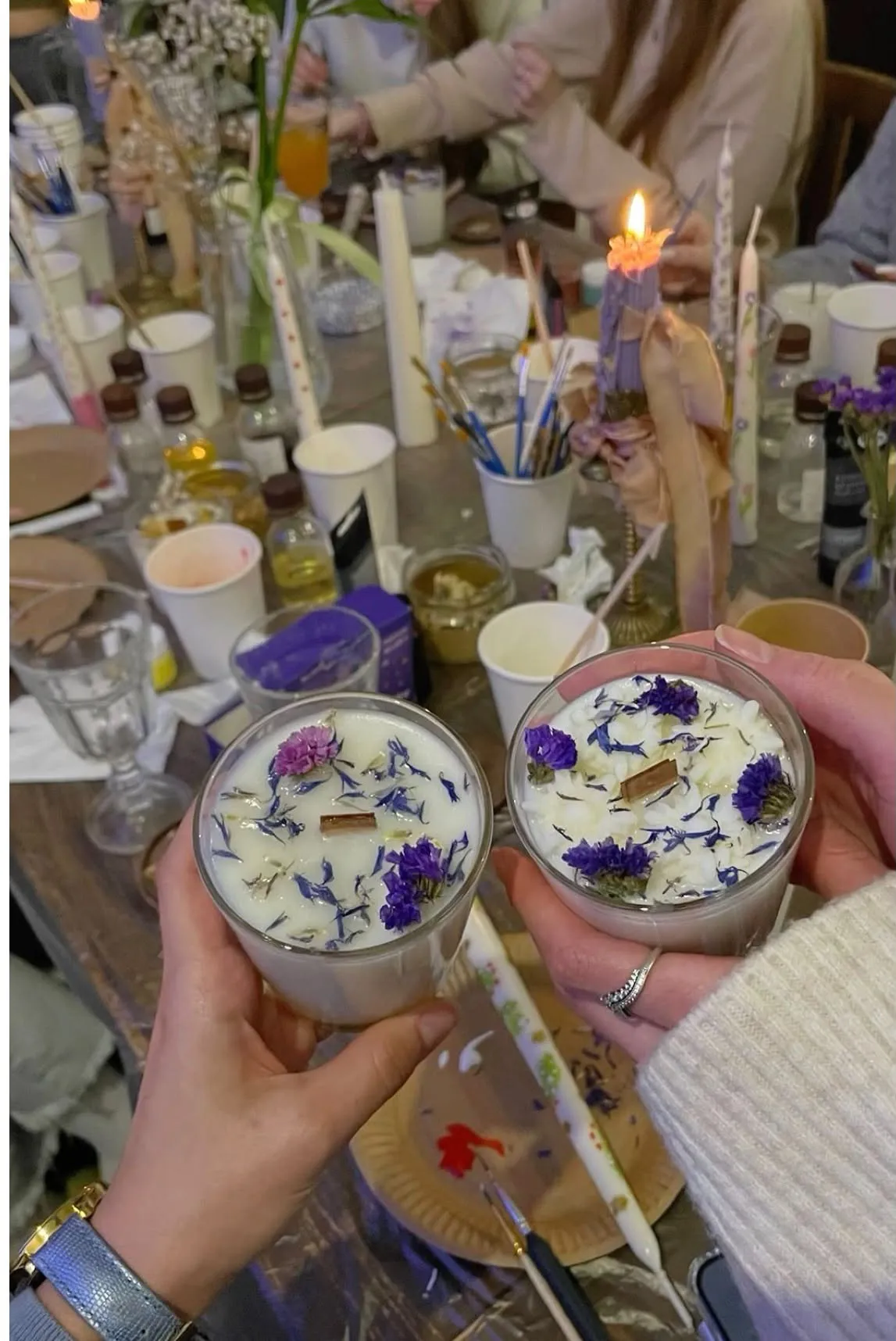
Making your own scented candle is one of the most satisfying DIY projects: little equipment, an hour of work, and a useful object that scents the house for weeks. It is also one where first attempts most often fail: a tunnel in the centre, a cracked surface, a fragrance you cannot smell once lit.
This guide follows exactly the method we teach in our candle workshop in Brussels, adapted to an ordinary kitchen, with the temperatures and dosages that make the difference.
The materials you need
- Soy wax flakes, 200 g for a 250 ml jar. It burns cleanly, holds fragrance well and cleans up with hot water.
- Cotton wick pre-tabbed on a metal base, sized for the jar diameter (the seller indicates the reference).
- Candle fragrance oil or essential oil, 6 to 10% of the wax weight, i.e. 12 to 20 g for 200 g.
- A heat-resistant container: glass jar, ceramic cup, metal tin.
- A pouring jug, a saucepan for the bain-marie, a kitchen thermometer, a clothes peg or wick centring tool, a scale.
Step 1: prepare the container and the wick
Clean and dry the jar, then stick the wick base right in the centre of the bottom with a dot of hot glue or a double-sided sticker. Pass the wick between the arms of a clothes peg laid across the rim to keep it straight and taut. A slightly warm jar (a few seconds with a hairdryer) limits bubbles and wet spots.
Step 2: melt the wax in a bain-marie
Weigh 200 g of flakes into the jug and set it in a saucepan of simmering water. The wax melts between 50 and 60°C; keep going to 70-75°C, stirring gently. Never melt wax directly on the hob or unattended in the microwave: it is flammable above 200°C.
Step 3: add the fragrance at the right temperature
This is the step everyone gets wrong. Take the jug off the bain-marie and let the wax cool to around 65°C, then pour in the fragrance and stir for a good two minutes to bind it. Too hot and the fragrance evaporates before it is fixed; too cold and it mixes poorly and “sweats” on the surface. Dosage: 8% of the wax weight is a good compromise, i.e. 16 g for 200 g.
Step 4: pour the wax
Let it cool further to 55-60°C, then pour slowly into the jar, leaving 1 cm below the rim. Wax poured too hot shrinks as it cools and creates a sinkhole or cracks; poured too cold, it leaves “skin” marks on the walls. If a small dip still appears around the wick, keep a little wax for a thin second pour the next day.
Step 5: let it rest, trim the wick
Let the candle cool at room temperature, away from draughts and the fridge, for 24 hours. Then trim the wick to 5 mm above the wax. Above all: wait one to two weeks before lighting it. This is the “curing” time needed for the fragrance to bind with the wax and really diffuse. A candle lit the same day always smells weaker.
The first burn
The first time, let the candle burn until the whole surface is liquid, usually two to three hours for a 250 ml jar. Wax has a “memory”: if you blow it out too early, it will tunnel down the centre on every subsequent burn and waste half the jar.
The five most common mistakes
- No scent throw: dosage too low, fragrance added at too high a temperature, or candle lit without curing.
- Cracked or sunken surface: wax poured too hot or cooled too fast (draught, fridge).
- Tunnel in the centre: wick too thin for the jar diameter, or first burn too short.
- Smoking flame and blackened glass: wick too thick or too long; trim to 5 mm before each burn.
- Fragrance sweating on the surface: dosage above 10%, or fragrance poorly incorporated.
Home-made or workshop: which to choose?
At home, the first candle costs around thirty euros in materials (a good part of it reusable), plus some washing up. In a workshop, everything is provided, temperatures are controlled, and you leave with a candle that works first time in an hour and a half, for €45 per person. The best approach is often to start with a workshop to learn the technique, then carry on at home. The candle workshop is also a lovely birthday idea with friends.
Want to learn with a facilitator? Break-it’s scented candle workshop takes place on Rue de Flandre in Brussels, every day from 10 am to 8 pm and without booking for individuals. For a group, request a quote.